Five pillars, dozens of tools, and one uncomfortable truth: "knowing AI" isn't one skill anymore.
A few years ago, calling yourself an "AI engineer" meant you could train a model in a Jupyter notebook and maybe deploy it behind a Flask endpoint. That bar has moved – a lot.
In 2026, the title "AI Software Engineer" doesn't describe a single job. It describes a stack of competencies that used to belong to five different people: the data scientist, the MLOps engineer, the prompt engineer, the search/retrieval engineer, and now – increasingly – the agent architect. Companies don't have the luxury of hiring five specialists for every AI feature, so the expectation has quietly shifted onto individuals: be fluent across the whole pipeline, from a messy CSV to a fleet of autonomous agents calling your internal APIs.
This is my attempt to map that pipeline honestly – not as hype, but as a working checklist. If you're planning your learning path for the next year, this is roughly the order I'd tackle it in.
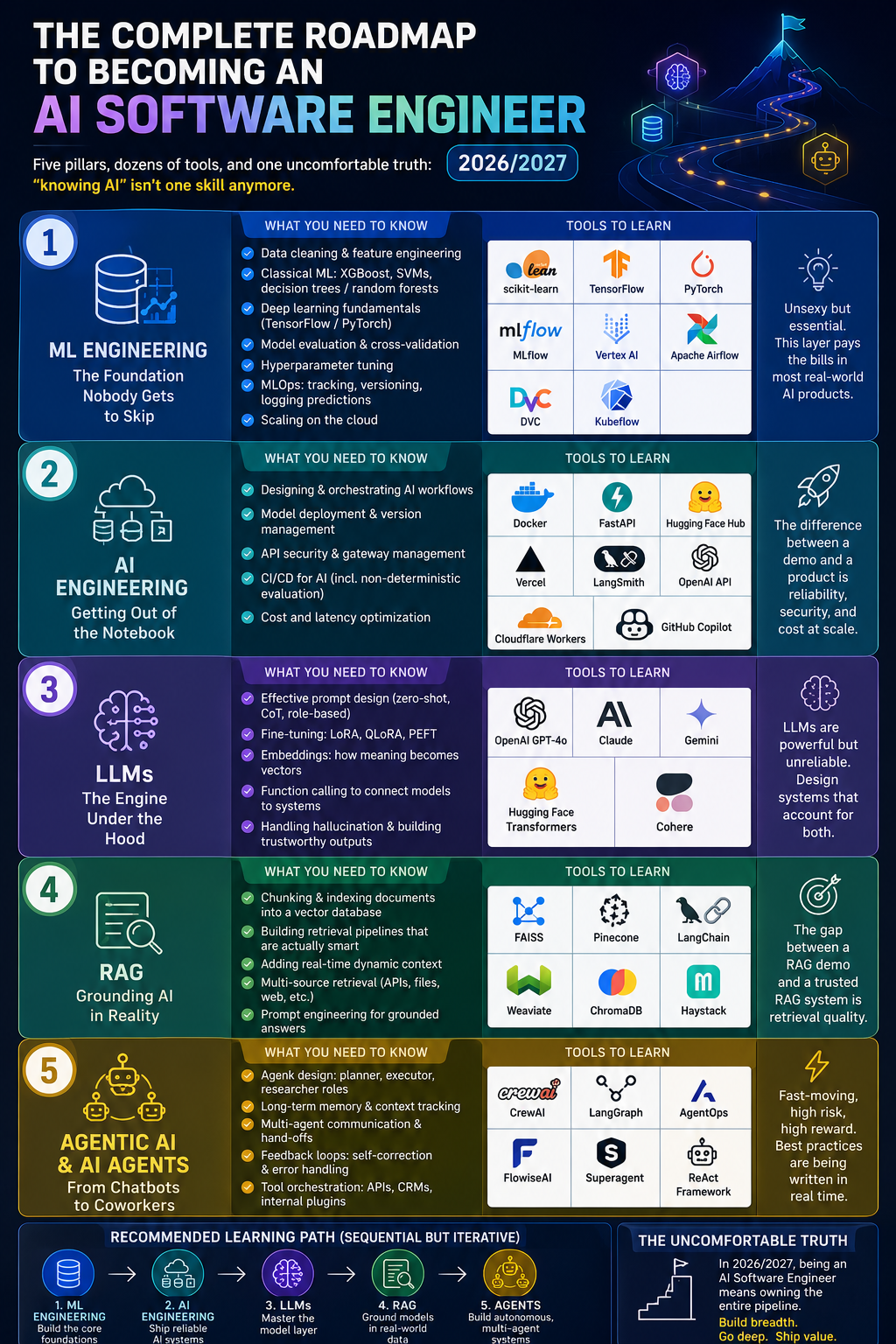
1. ML Engineering – The Foundation Nobody Gets to Skip
It's tempting to jump straight to LLMs and agents because that's where the excitement (and the job postings) are. But underneath almost every "AI product" is still a boring, classical machine learning problem: predicting churn, scoring leads, detecting fraud, ranking recommendations. These problems don't need a 70-billion-parameter model – they need clean data and a well-tuned gradient-boosted tree.
What you need to know:
- Data cleaning & feature engineering – still the highest-leverage skill in the entire field. Garbage in, garbage out applies just as much to LLM pipelines as it does to a logistic regression.
- Classical machine learning – XGBoost, SVMs, decision trees/random forests. These remain the default choice for tabular data because they're fast, interpretable, and shockingly hard to beat.
- Deep learning fundamentals – enough TensorFlow/PyTorch to build, train, and debug neural networks when the problem actually calls for one (images, audio, sequences).
- Model evaluation & cross-validation – knowing why your model is "good" (and where it quietly fails) matters more than squeezing out another 0.5% accuracy.
- Hyperparameter tuning – grid search, Bayesian optimization, or just knowing when "good enough" is good enough.
- MLOps – tracking experiments, versioning models, logging predictions in production. A model that isn't monitored is a model that's already decaying.
- Scaling on the cloud – training and serving models when "my laptop" stops being a valid environment.
Tools to learn: scikit-learn, TensorFlow, PyTorch, MLflow, Vertex AI, Apache Airflow, DVC, Kubeflow
This layer is unglamorous, but it's also the layer that pays the bills in most companies that aren't building foundation models. Don't skip it just because it's not trending on X.
2. AI Engineering – Getting Out of the Notebook
Here's where things shift from "can I make this work once" to "can I make this work reliably, for thousands of users, without bankrupting the company." A working prototype is maybe 20% of the actual job.
What you need to know:
- Designing & orchestrating AI workflows – combining LLMs, tools, and memory into something that behaves like a coherent system rather than a single API call.
- Model deployment & version management – shipping updates without breaking the product, and being able to roll back when (not if) something goes wrong.
- API security & gateway management – your AI endpoints are now an attack surface; treat them like one.
- CI/CD for AI – testing, deploying, and monitoring AI features the same rigorous way you'd treat any other production code, plus the new wrinkle of evaluating non-deterministic outputs.
- Cost and latency optimization – the difference between a demo and a real product is usually whether it's fast and cheap enough to actually run at scale.
Tools to learn: Docker, FastAPI, Hugging Face Hub, Vercel, LangSmith, OpenAI API, Cloudflare Workers, GitHub Copilot
This is the layer that separates engineers who can build a demo from engineers who can ship a product. It's also, not coincidentally, the layer most hiring managers actually care about.
3. LLMs – The Engine Under the Hood
This is the part everyone thinks they already understand because they've used ChatGPT. Using an LLM and engineering with one are very different skills.
What you need to know:
- Effective prompt design – zero-shot, Chain-of-Thought, role-based prompting. Small wording changes can swing output quality dramatically, and that's not a hack, it's a discipline.
- Fine-tuning – LoRA, QLoRA, PEFT. These techniques let you adapt a general-purpose model to a specific domain without retraining the whole thing from scratch.
- Embeddings – understanding how meaning gets encoded into vectors is the key to smarter search, clustering, and context handling.
- Function calling – wiring a model into your actual systems so it can call APIs, query databases, or trigger workflows, instead of just generating text into a void.
- Handling hallucination – arguably the single most important skill in this section. Knowing when a model is making things up, and designing around that, is what separates a toy from a trustworthy product.
Tools to learn: OpenAI GPT-4o, Claude, Gemini, Hugging Face Transformers, Cohere
Treat the LLM as a powerful but unreliable collaborator – brilliant most of the time, confidently wrong some of the time. Your job is to design systems that account for both.
4. RAG – Grounding AI in Reality
If LLMs are the brain, Retrieval-Augmented Generation is the part that gives that brain access to facts it didn't memorize during training – your company's documents, your product's live data, today's news. Almost every serious AI assistant or internal chatbot you've used is built on this pattern.
What you need to know:
- Chunking & indexing documents into a vector database – how you split content matters as much as what model you use to embed it.
- Building retrieval pipelines that are actually smart, not just "grab the top 5 nearest vectors and hope."
- Adding real-time dynamic context so answers reflect what's true now, not just what was true when the index was built.
- Multi-source retrieval – pulling from APIs, files, and web scraping, and reconciling all of it into a coherent context window.
- Prompt engineering for grounded answers – getting the model to actually use the retrieved context instead of ignoring it and hallucinating anyway.
Tools to learn: FAISS, Pinecone, LangChain, Weaviate, ChromaDB, Haystack
RAG is deceptively simple to prototype and notoriously hard to get right. The gap between a RAG demo and a RAG system people actually trust is almost entirely in retrieval quality, not model quality.
5. Agentic AI & AI Agents – From Chatbots to Coworkers
This is the frontier, and it's where the field is moving fastest. A single chatbot answering questions is no longer the ceiling – the real shift is toward teams of agents that plan, delegate, execute, and check each other's work, the way a small team of humans would tackle a research task or a multi-step operational process.
What you need to know:
- Agent design – defining clear roles like planner, executor, and researcher, instead of asking one model to do everything badly.
- Long-term memory – episodic memory and context tracking so an agent doesn't forget what it did five steps ago.
- Multi-agent communication – getting agents to pass information and hand off tasks to each other reliably.
- Feedback loops – self-correction and error handling, so agents can recover instead of silently failing or looping forever.
- Tool orchestration – connecting agents to real-world systems: APIs, CRMs, internal plugins.
Tools to learn: CrewAI, LangGraph, AgentOps, FlowiseAI, Superagent, ReAct Framework
This layer is still maturing – the tooling changes fast, and best practices are being written in real time. That makes it the highest-risk, highest-reward area to specialize in right now.
Putting It Together
None of these five pillars exist in isolation, and that's really the point. A production AI feature in 2026/2027 typically looks something like:
Clean data feeding a classical model for scoring (ML Engineering) → wrapped in a production-grade API with monitoring (AI Engineering) → calling an LLM for reasoning and generation (LLMs) → grounded in your company's actual data through retrieval (RAG) → orchestrated by one or more agents that plan and execute multi-step tasks (Agentic AI).
You don't need to master all five before you start building. Most engineers I know got here by going deep on one layer (often LLMs or RAG, since that's where the job market noise is loudest) and then filling in the gaps as their projects demanded it. But if you're mapping out a learning plan for the next 12–18 months, this is the order that tends to compound the best: solid ML foundations first, then production engineering discipline, then LLM fluency, then RAG, then agents.
The tools in this list will absolutely change. Some of them won't exist in two years; others not yet invented will replace them. The five categories of skill, though, are a much safer bet – they map to durable problems (clean data, reliable systems, language understanding, factual grounding, multi-step execution) that won't go away just because the tooling around them does.
If you can move comfortably across all five, you're not just keeping up with AI engineering in 2026/2027 – you're the person who can actually ship it.