Ever wondered how thousands of users can read and write to the same database table at the same time without everything grinding to a halt? The answer, in most modern databases (PostgreSQL, MySQL/InnoDB, Oracle, and others), is a clever mechanism called MVCC – Multiversion Concurrency Control.
Let’s break it down in plain language, with a simple example you’ll never forget.
What Is MVCC?
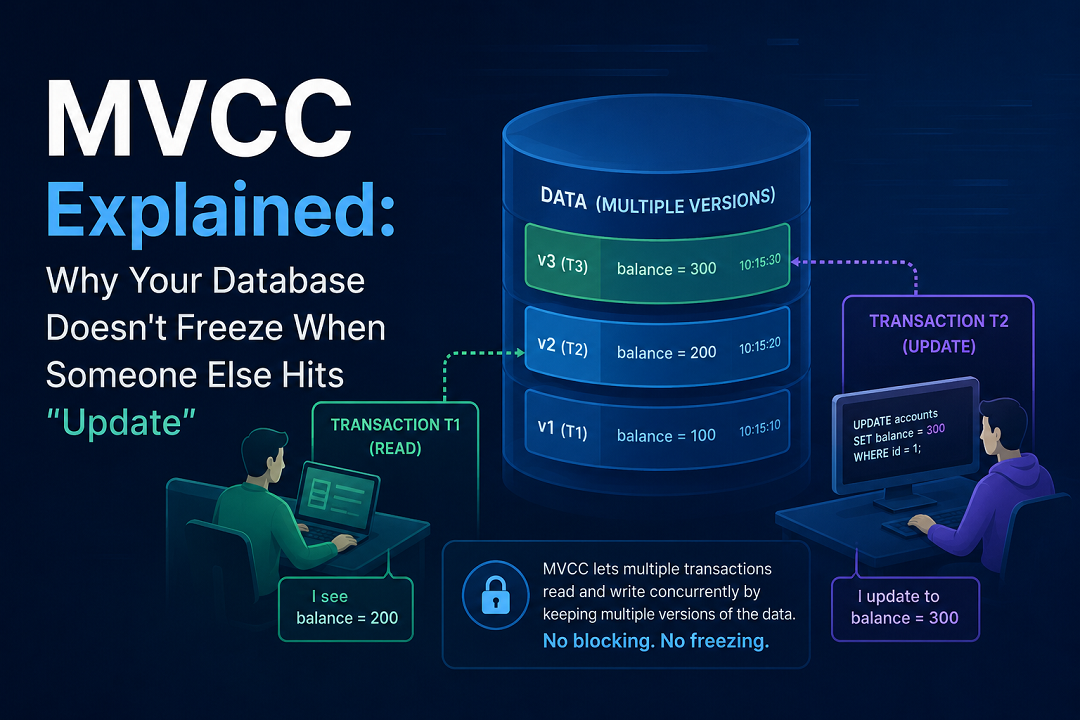
MVCC is a concurrency control method that lets a database handle multiple transactions at once by keeping several versions of the same piece of data instead of just one.
Here’s the key idea: when a transaction wants to read data (a SELECT), it should never be blocked by another transaction that’s currently writing to that same data (an UPDATE or DELETE).
Instead of overwriting data in place, the database creates a new version every time a row changes. Old versions don’t disappear immediately – they stick around just long enough for any transaction that started before the update to keep seeing the data as it was when they started.
Picture a single record evolving over time:
Original Data --UPDATE--> Version 1 (old) → Version 2 (newer) → Version 3 (newest)
All these versions coexist for a while. Readers and writers simply look at different versions depending on when their transaction began.
A Concrete Example: The Bank Account

Let’s say we have an accounts table, and one row starts with a balance of $1,000.
10:00 – Transaction T1 begins (reading the balance)
T1 asks: "What’s the current balance?" It sees Version 1: $1,000, committed at 09:59.
10:01 – Transaction T2 begins (updating the balance)
T2 transfers in $500. The database doesn’t overwrite the existing row – it creates a brand new version.
10:02 – T2 commits
A new version now exists: $1,500.
10:03 – T1 is still reading… and is not blocked
Even though T2 already committed a newer version, T1 keeps reading Version 1 ($1,000) – because that was the version that existed when T1’s transaction started at 10:00. T1 continues working with a consistent snapshot of the data, completely unaware that T2 ever touched the row.
10:05 – T1 finishes and starts a new read
Now T1 sees the updated balance: Version 2, $1,500 – because T2’s transaction has committed and any new read sees the latest committed version.
This is the magic of MVCC: T1 was never locked out, and T2 was never blocked either. Each transaction simply worked with the version of the data that matched its own point in time.
How Does MVCC Actually Work Under the Hood?
It comes down to four mechanics:
-
Hidden metadata on every row. Each row carries extra fields like
created_by_tx,created_at,deleted_by_tx, anddeleted_at(in some databases these are called transaction IDs and rollback pointers). This metadata tells the engine which transaction created a version and which one (if any) deleted it. -
Updates and deletes don’t overwrite – they version. An
UPDATEdoesn’t modify a row in place. It marks the old version as "deleted by this transaction" and inserts a new version "created by this transaction." -
Every transaction gets a "read view" (snapshot). The moment a transaction starts, the database takes a snapshot of which versions are considered valid at that exact moment.
-
Reads are filtered through that snapshot. When a transaction reads data, the database doesn’t just hand over the latest row – it checks the read view and returns only the version that was valid at the transaction’s start time.
T1 starts at 10:00 → Read View (snapshot @10:00) → Database
                                                        ↓
                                    Only versions valid at 10:00 are visible
Why Does This Matter?
MVCC isn’t just a clever trick – it’s the backbone of how modern databases stay fast and reliable under heavy concurrent load. The benefits are substantial:
- Reads never block writes, and writes don’t block reads. This dramatically increases concurrency.
- Lower lock contention. Because readers don’t need locks to protect against writers, the database spends less time waiting and more time working.
- Consistent snapshots. Every transaction sees a stable, self-consistent view of the data for its entire duration – no weird half-updated reads.
- Built for multi-user systems. Whether it’s a banking app, an e-commerce platform, or a SaaS product with thousands of concurrent users, MVCC is what keeps things responsive.
The Tradeoffs: MVCC Isn’t Free
As powerful as MVCC is, it doesn’t come without costs. Keeping multiple versions of every row around has real consequences:
-
Storage bloat. Every update creates a new version instead of overwriting the old one, so the database accumulates dead/old row versions over time. This eats up disk space if left unchecked.
-
Vacuum / garbage collection overhead. Old versions that are no longer visible to any active transaction need to be cleaned up eventually (Postgres calls this
VACUUM; MySQL/InnoDB calls it purging the undo log). If this cleanup falls behind – say, because a long-running transaction is still holding a reference to an old snapshot – table and index bloat can pile up fast, hurting performance. -
Long-running transactions are expensive. If one transaction stays open for a long time, the database may have to retain many old versions just to keep that transaction’s snapshot consistent. This can spike storage usage and slow down vacuum/cleanup processes for everyone else.
-
More complex query planning. The database has to do extra work – checking visibility rules against the read view – every time it scans a row, which has a small but real CPU cost compared to checking a single value with locks.
-
It doesn’t replace all locking. MVCC handles reader/writer conflicts well, but two transactions trying to update the same row concurrently still need locks or conflict resolution. MVCC solves read-vs-write contention, not write-vs-write contention.
The takeaway here is that MVCC trades a bit of storage and bookkeeping overhead for a massive gain in concurrency – a tradeoff that’s almost always worth it for read-heavy, multi-user systems, but one that means MVCC databases need to actively manage old versions (vacuuming, version cleanup) to keep running smoothly.
The Takeaway
MVCC essentially gives your database the ability to "look into the past." By preserving multiple versions of data, multiple transactions can work side by side – reading, writing, updating – without stepping on each other’s toes.
Next time your application handles a flood of simultaneous reads and writes without falling over, you’ll know there’s a good chance MVCC is quietly doing the heavy lifting behind the scenes.